The largest single wave of capital investment in the history of construction is not being driven by governments, wars, or population booms. It is being driven by the insatiable computing appetite of artificial intelligence. The question is no longer whether this wave will strain the construction industry's supply chain. It already has. The question is whether the industry can adapt fast enough to deliver.
The Scale Is Without Precedent
The numbers are staggering — and they are real.
According to data tracked by Opus Project Intelligence, Great Project Solutions' proprietary market intelligence tool, there are currently 118 data centre projects and 23 semiconductor fabrication projects active across the United States, representing a combined $965 billion in total investment capital. Of those, 79 data centre projects and 17 semiconductor projects are actively under construction — collectively committing $736 billion of simultaneous construction demand to a sector that, as recently as 2021, had rarely seen a single year of national construction starts exceed $20 billion.
Consider the trajectory: US data centre construction starts totalled $14.9 billion in 2023, jumped to $26.9 billion in 2024, and soared to $77.7 billion in 2025 — a staggering 190% year-over-year increase, according to ConstructConnect data published in June 2026. Since 2021, the sector has doubled annually, achieving a four-year compounded annual growth rate of 98%. The average cost of a data centre project rose to $597 million in the twelve months ending November 2025 — a 60% increase in average project scale in a single year.
The Investments Driving the Surge
The data in Opus Project Intelligence tracks $1.88 trillion of active US construction across 366 projects. Of that, $965 billion is driven by AI infrastructure — data centres and semiconductor fabrication — with $736 billion actively under construction today. The question is no longer whether this will test the industry. It already has.
To understand the pressure on the supply chain, one must first understand the geography and scale of the commitments being made. Across the Opus-tracked universe, $476 billion in total investment cost is expected to be delivered between June 2026 and June 2028 alone — across projects currently under construction or in advanced planning. The chart below illustrates how that capital is distributed across sectors.
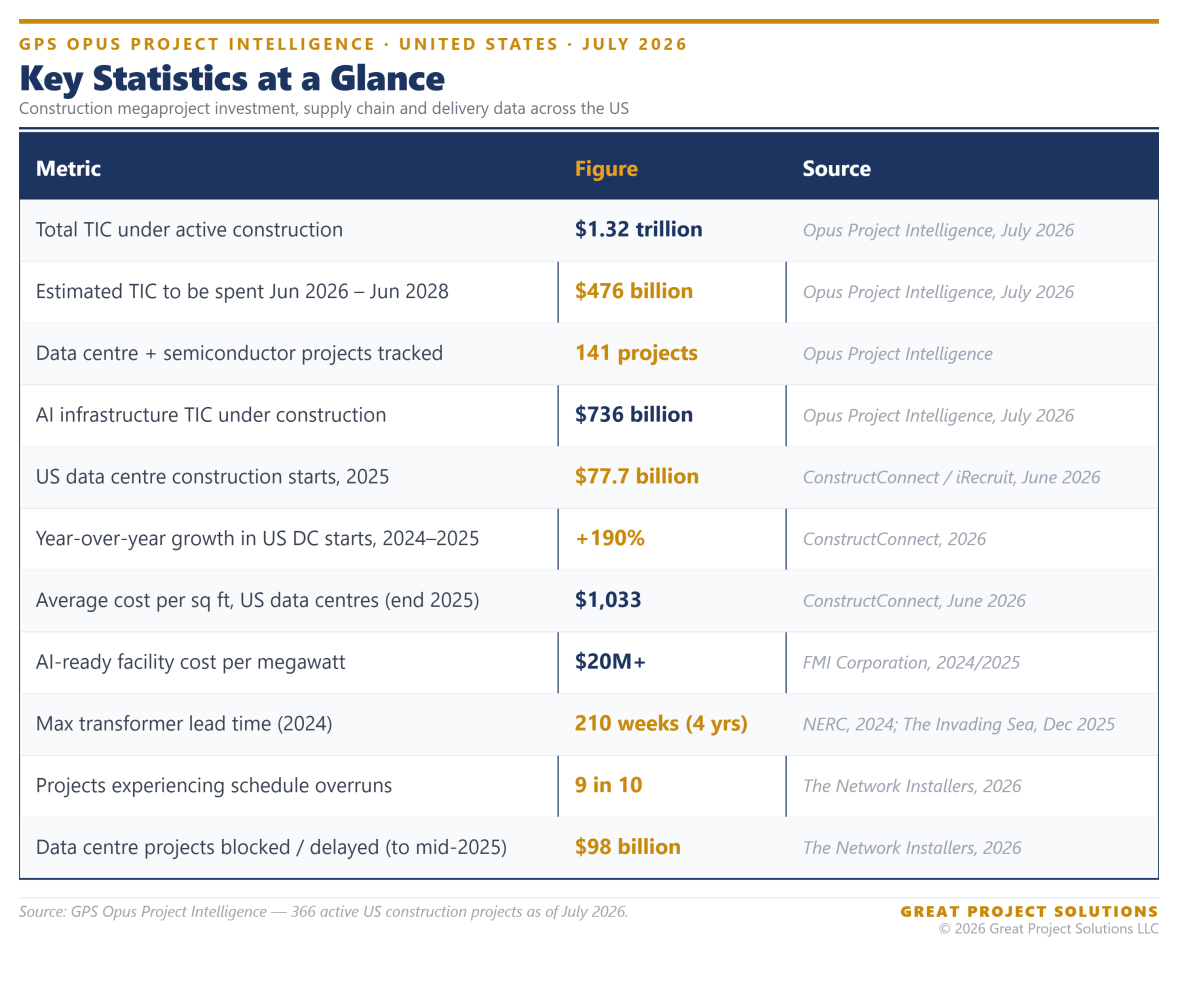
Datacenters ($177B, 37.1%) and Semiconductors ($94B, 19.5%) together account for more than half of all tracked capital expenditure in the window. The remaining $205 billion is distributed across Oil & Gas ($40B), Rail ($30B), Life Science ($28B), Aviation ($19B) and a further ten sectors — each representing between 1% and 4% of the total.
The hyperscaler technology companies — Amazon (AWS), Microsoft, Google, Meta, Oracle, xAI and Apple — have collectively committed to US data centre programmes running into the hundreds of billions of dollars. Google alone has announced $40 billion for Texas, $9 billion for South Carolina, $9 billion for Virginia, $10 billion for Arkansas and $7 billion for Iowa. Meta's Hyperion campus in Richland Parish, Louisiana — a single facility — carries a $27 billion price tag and a 5-gigawatt compute capacity target. Oracle and OpenAI's Stargate programme has committed $500 billion in US AI infrastructure investment over five years. Oklahoma has emerged as one of the most active new data centre states, with Google, Core Scientific and others committing over $9 billion to the state.
On the semiconductor side, the picture is equally dramatic. The CHIPS and Science Act has catalysed an extraordinary reshoring of semiconductor manufacturing. Micron Technology has expanded its US commitment to $200 billion — encompassing a $100 billion megafab in Clay, New York, a $15 billion Fab 1 expansion in Boise, Idaho, and a $28 billion Idaho Fab 2 accelerated in 2026. TSMC has committed over $60 billion across three fab phases in Chandler, Arizona, complemented by Amkor Technology's $2 billion advanced packaging facility in Peoria — completing a full domestic AI chip supply chain within Maricopa County. Intel is building simultaneously in New Albany, Ohio ($28B), Chandler, Arizona ($20B), and Hillsboro, Oregon ($36B). Samsung is constructing a $44 billion foundry campus in Taylor, Texas.
Where the Supply Chain Is Breaking
The Transformer Crisis
The most acute constraint is the one least visible to the general public: electrical transformers.
The North American Electric Reliability Corporation reports that the lead time for large power transformers hit roughly 120 weeks — more than two years — in 2024, with the largest units taking as long as 210 weeks, or four years. Transformers now cost four to six times what they cost before 2022. The root cause is structural: transformer cores require grain-oriented electrical steel made domestically only by Cleveland-Cliffs, and roughly 80% of large transformers have historically been imported from Mexico, China and Thailand. When a single gigawatt-scale AI campus requires 1,400 megawatts of power — as Oracle's Saline Township, Michigan project does — the transformer procurement program alone can take longer than planning, permitting and site preparation combined.
Equipment Lead Times: Engineered to Order, Impossible to Rush
Lead times for equipment delivery range from eight to 24 months, while critical generators and UPS systems face 12 to 18-month waits. The problem is compounded by the shift in computing architecture: traditional data center server racks consumed 5–10 kilowatts; AI compute racks now require 40–130 kilowatts — up to 26 times more power density. The average cost per square foot for data centers surpassed $1,000 for the first time, reaching $1,033 by end of 2025. AI-ready facilities run $20 million or more per megawatt, versus $10–12 million for standard builds.
The Skilled Labour Cliff
The construction workforce was not built for this moment.
Electricians, ironworkers, pipefitters, and specialized data center tradespeople are in critically short supply. The problem is generational: for decades, fewer young Americans entered the skilled trades, while immigration constraints have limited the inflow of experienced workers. The retirement of baby-boomer tradespeople is accelerating the gap.
The most acute expression of the labor shortage is hyper-local. Phoenix / Chandler, Arizona hosts over $180 billion in AI infrastructure investment simultaneously — TSMC, Intel, Amkor and Google within 30 miles of each other, competing daily for the same cleanroom specialists and MEP tradespeople. Lebanon, Indiana (population 16,000) is absorbing nearly $47 billion of concurrent construction across Eli Lilly, Meta, Amazon and SK Hynix. New labor clusters are forming in Oklahoma, Wyoming and West Virginia, placing extraordinary pressure on regional workforces calibrated for a fraction of this demand.
The Cost of Inaction: Overruns Are Already Here
Nine out of ten large infrastructure projects experience schedule overruns. The industry's own data tells the story: $98 billion in data center projects were blocked or delayed to mid-2025. In 2025 and early 2026, roughly 30% to 50% of large-scale projects faced delays or cancellations.
The Opus data reveals three structural patterns that characterize the current delivery environment:
- Schedule slippage is systemic, not exceptional. Across the 229 projects currently under construction in Opus, virtually every semiconductor fabrication project has experienced at least one material schedule revision, with extensions averaging 18 to 24 months from originally announced timelines. Power procurement, transformer lead times and cleanroom qualification are the most commonly cited causes.
- Project rescoping is increasingly used as a cost management tool. Rather than cancelling projects when costs rise, owners are restructuring scope to maintain momentum while reducing peak capital demand. Single-phase designs replacing multi-phase programs, modular approaches replacing monolithic campuses, and phased capacity targets with expansion optionality have all become common features of the construction pipeline.
- Community opposition is becoming a structural constraint on the development pipeline. Data center developments in Montana, Minnesota, New Jersey, West Virginia and Illinois have all encountered organized opposition in 2025–2026, with concerns ranging from electricity price increases and water consumption to traffic and noise. In PJM-served markets, data centers have been directly linked to measurable consumer electricity price increases, providing organized opposition with an economic argument that is difficult to refute.
What the Industry Must Change
The Bain & Company analysis (October 2025) identified four proven actions that can reduce data center construction timelines by up to a year. We would like to emphasize three of them as the crucial ones for major project delivery:
- Procurement-centric engineering: Integrating procurement into design from the outset. Placing transformer and switchgear orders 24–36 months before planned energization is now a minimum requirement, not a best practice. Furthermore, engineering around procurement must be a consideration.
- Modular design and prefabrication: Reducing on-site work volume by moving production into controlled factory environments. In reality, most projects fail to maximize the potential of modularization as it tends to be an afterthought in schedule-driven projects.
- Supplier collaboration and long-term partnering: Building long-term relationships with equipment manufacturers, and more importantly, construction and trade contractors. Securing capacity and skills will be the critical factor in the battle for schedule delivery.
Beyond these, the industry needs to confront a fundamental productivity challenge. US construction productivity has declined by approximately 20% in real terms since the 1960s — even as manufacturing productivity has doubled. Lack of alignment between Owners and the supply chain generates friction, wastes time and leads to inefficiencies and lack of performance. The consequences of not addressing the productivity challenge in megaprojects are measured in billions of dollars of cost overruns.
The Opportunity in the Constraint
The supply chain crisis is, simultaneously, an opportunity. Every transformer manufacturer, every electrical contractor, every modular construction firm, every workforce development program, and every technology platform that helps construction teams work more efficiently stands at the center of a generational demand wave.
The construction industry is responding with creativity. The Walbridge/Oracle Michigan Stargate campus produced the first project labor agreement for a data center in US history — covering 2,500 union tradespeople and representing a model for addressing the labor gap at scale. Riggs Distler's assembly of Sunrise Wind's offshore foundation components at the Port of Coeymans demonstrates the application of advanced manufacturing techniques to infrastructure construction. Bechtel's modular and digital-enabled approach to the Micron New York EPC represents the integration of process engineering discipline into a traditionally sequential program.
The companies and contractors that invest now in the capabilities, partnerships, and technologies needed to deliver this program reliably — on time and within budget — will define the next generation of the US construction industry. Those that do not adapt will find themselves outpaced by a wave they helped create.
Key Statistics at a Glance
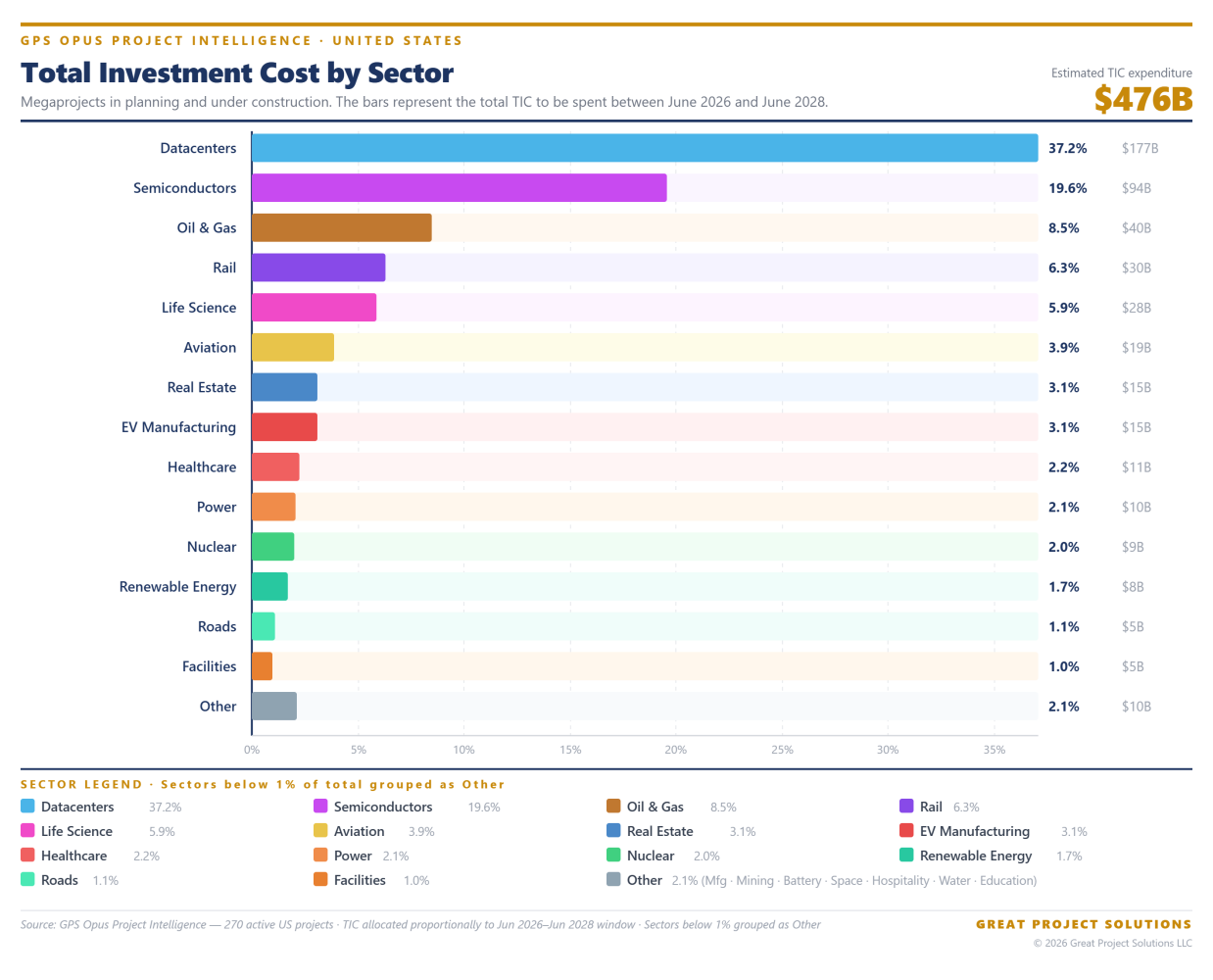
This report was produced using Opus Project Intelligence, Great Project Solutions' proprietary construction project database tracking 366 active US construction projects with a combined estimated investment value of $1.88 trillion as of July 2026. Great Project Solutions is a specialist project intelligence and advisory firm serving owners, contractors and investors in the construction sector.
References
- Data Center Dynamics — "Why a construction worker shortage could hamper the US data center build-out" — May 2026
- Bain & Company — "Next phase of data center growth to be more disciplined but risks of power constraints and construction delays remain" — October 22, 2025
- Allianz Commercial — "The Data Center Construction Boom" — 2025
- The Invading Sea — "Supply-chain delays, rising equipment prices threaten power grid" — December 5, 2025
- The Network Installers — "30+ Data Center Construction Statistics, Market Size & Trends (2026)" — 2026
- iRecruit / ConstructConnect — "Data Center Construction Cost Trends 2026" — June 2026
- Milrose Consultants — "Factors Delaying Data Center Projects" — June 12, 2025
- Wesco — "Solving Data Center Development Challenges" — April 14, 2026
- FMI Corporation — Data Center Construction Market Outlook — 2024/2025
- NERC (North American Electric Reliability Corporation) — Long-Term Reliability Assessment — 2024
- Construction Dive — "Micron taps Bechtel as EPC for New York fab" — June 2026
- Nucor Corporation — Q1 2026 Earnings Call / Apple Grove project updates — April 2026
- Offshore Wind Biz — "Jan De Nul completes Sunrise Wind cable laying" — April 2026
- Opus Project Intelligence — US Construction Project Database (366 active projects, July 2026) — Great Project Solutions